
Introducing The Pull™ Playbook.
There's something I keep coming across in branding that makes me a little mental, particularly because it often shows up in work that's otherwise really well done.
A company invests in a new brand strategy. There's research, discovery, thoughtful copywriting, beautiful design and a presentation that brings everything together. Somewhere in that presentation is a section labelled "Our WHY," and underneath it is a lovely description of what the company does, how it does it or what customers can expect when they work with them.
And I find myself thinking, that's great, but it's not your WHY.
Sometimes it's a brand promise. Sometimes it's a mission statement. Occasionally it's a founder's story that's been given a more inspirational heading. All perfectly useful things to have, but they're doing different jobs, and I think we're losing something important when we treat them as interchangeable.
I don't think anyone's deliberately getting it wrong. Branding has more overlapping terminology than most people know what to do with, and even among experienced marketing professionals, there isn't always agreement on what these concepts mean.
But when we're talking about WHY in the context of Simon Sinek's work, there's an important distinction worth understanding. The whole point of uncovering your WHY is to identify the thread that exists independently of the products and services you offer, because those are simply the ways you've chosen to bring that belief to life. Your WHY is what drives you to do the work in the first place, and it's what continues to matter even if the work itself changes.
Here's where we keep getting it wrong.
Let's use a wealth management firm as an example, because I once worked with someone whose perspective on financial planning was shaped by something much more interesting than investments.
His wife was a nutritionist, and well-being was something their household genuinely believed in. Not just eating well or staying active, but the bigger picture of what it means to live a healthy, balanced life. He saw financial well-being as an important part of that equation, because financial stress has a way of affecting just about everything else.
Now imagine taking that thinking into a traditional branding exercise.
The firm's WHY might end up sounding something like this:
"We exist to provide personalized financial planning and investment advice that helps families achieve long-term financial security."
There's nothing particularly wrong with that statement, and I'm sure there are plenty of firms that could put it on their websites tomorrow. Which, incidentally, is part of the problem and exactly what we’d see if we took a peek at c
It describes the business and what clients can expect from it, but it doesn't tell us much about what the people behind it actually believe.
What interested me about this particular perspective was that the underlying belief had very little to do with investments. It was about well-being, and the idea that financial health is one part of a much bigger picture.
If we followed that belief a little further, we might arrive at a WHY along these lines:
"To help people create greater balance and well-being in their lives, so they have the freedom to focus on what matters most."
Now we're talking about something that could guide a business well beyond its current products and services.
Financial planning is simply one way of contributing to that belief. The same WHY could conceivably inspire work in education, family support or any number of other areas that contribute to people's overall well-being.
And this is why I think the discovery process is so important. If we'd started and stopped with what the firm did, we might never have uncovered the thinking that made its approach interesting in the first place.
And your brand promise? That's something else entirely.
This is probably the distinction I see misunderstood most often, and I suspect it's because a well-written brand promise can sound an awful lot like a WHY.
Both can be meaningful, aspirational and make you feel pretty good about the company you're reading about, but a brand promise tells people what they can count on when they engage with your business. It's the experience, benefit or standard you're committing to deliver through your products, services and the way you work.
For our wealth management example, a promise might be:
"Financial guidance that considers your whole life, not just your investments."
I actually quite like that. It's clear, it's relevant to the firm's philosophy and it gives prospective clients a sense of what makes the approach different.
But notice that it talks about financial guidance. It's describing something the company delivers, which makes it a promise rather than a WHY.
The WHY explains the belief behind the business and should exist independently of the products and services it offers. Those products and services are simply the ways the organization has chosen to bring that belief to life.
Here's a question worth asking the next time you're looking at a brand strategy, whether it's your own or one you're developing for someone else.
If you removed every reference to the company's products, services and industry, would its WHY still make sense?
If the answer is no, there's a good chance you haven't quite reached it yet.
Your founder story isn't your WHY either.
I love a good founder story, particularly when there's something personal behind the decision to start a business. Those experiences can make a brand feel human and give people a reason to connect with the person behind it. And quite often, they're where some of the most interesting clues to a company's WHY can be found.
But there's a difference between telling the story of how a business began and understanding the belief that inspired it.
Think about our financial advisor again. The fact that his wife was a nutritionist and that well-being was important in their household is an interesting part of his story. It helps explain how he came to see financial planning as something much bigger than managing money. But the real insight is in the belief that emerged from those experiences and how that belief continues to influence the contribution he wants to make.
And that's where I think the best brand discovery work happens. It's about getting curious enough to look beyond the events themselves and understand why they mattered, what they reveal about the person behind the business and how those beliefs continue to shape the work they do today.
Introducing The Pull™ Playbook.
It's not about what you do. It's about what happens in others because of what you do.
That line captures something I've believed for a long time, and it's really at the heart of the work I do through The Pull™.
I've spent years helping businesses figure out what makes them different, and I've come to believe that the most important work happens long before we get anywhere near a logo or a website. It's about understanding what drives the business, who it's really here to serve and how to bring those things together in a way that feels meaningful to the right people.
My philosophy has always been Branding from the inside, out, heavily influenced by Simon Sinek's work and the idea that we need to understand what drives a business before we can meaningfully communicate what makes it different.
I've started putting that thinking into something I'm calling The Pull™ Playbook, a practical approach to building a brand from the inside out, beginning with your WHY and moving through three stages: Direction, Strategy and Expression.
Eventually, I want this to be something business owners can use themselves to take a good, hard look at their brands, figure out what's missing and make them better. Because sometimes the thing holding a business back isn't the marketing, the website or the logo. It's the thinking underneath it.
And that's a much more interesting place to start.
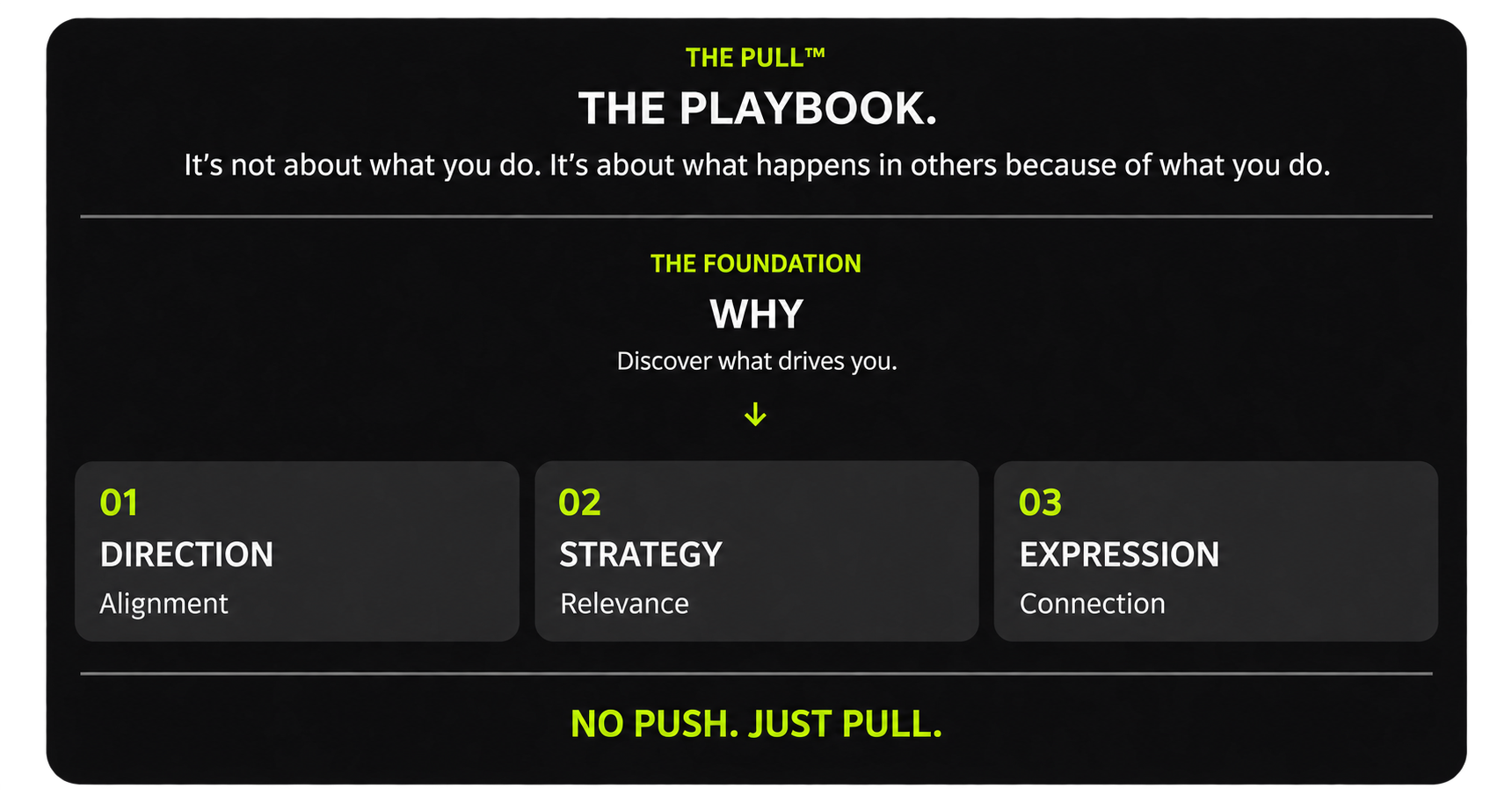
The Pull™ Playbook framework begins with WHY as its foundation, followed by three stages: Direction (Alignment), Strategy (Relevance) and Expression (Connection). Built around the belief that it's not about what you do, but what happens in others because of what you do. No Push. Just Pull.
The foundation: WHY
Before we start talking about audiences, competitors, logos or messaging, we need to understand the underlying belief that gives the organization its reason for being.
Simon Sinek describes a WHY as a purpose, cause or belief, and his approach encourages us to look at the contribution we make and the impact it has on others.
For entrepreneurs, there's an additional distinction worth understanding because your personal WHY and your company's WHY may be closely connected without being identical.
Your personal WHY is that thread that keeps showing up throughout your life. It's the thing you're naturally drawn to do, regardless of your profession or the business you happen to own. It's often been there long before you had the language to describe it, and when you finally recognize it, a lot of your choices and experiences start to make sense.
For me, that thread has always been helping people see how awesome they are.
Through Collective Photo Co., I get to show people something wonderful about themselves through photography. Through my marketing firm, The Brand House, I help business owners recognize what makes them and their businesses special. The work is completely different, but the thing that draws me to it is remarkably similar.
Collective Photo Co. also has its own organizational WHY:
"We believe in our collective ability to lift those around us in meaningful ways."
And because we don't take ourselves too seriously, we follow that with:
"Oh, and we also take awesome photos."
Which is a pretty good illustration of the distinction. Our belief is about community and lifting people up. Photography happens to be the way we've chosen to contribute to that belief.
Your organizational WHY needs to be something others can understand and contribute to, particularly if the organization eventually grows beyond its founder.
The personal and organizational WHY can work beautifully together, but they don't need to be identical.
And once we understand that foundational belief, we can begin translating it into something useful for the organization.
01. Direction: Getting clear on who you are and where you're going.
I've grouped vision, mission, values and beliefs, and positioning under one stage called Direction because together they help answer some pretty important questions about the business.
Your vision describes the future you're hoping to help create, while your mission explains the work you're undertaking to move toward it. The mission is closely connected to your HOW, which is often where your philosophy and process come together to make your approach distinctive.
Your values and beliefs establish the principles that guide your decisions and the way you conduct business. These should be things you genuinely live by, rather than a collection of attractive words that could just as easily appear on the wall of any other company.
And then there's positioning, which I think is one of the most interesting parts of this process because it's where we begin connecting what the organization stands for with the people it's best suited to serve.
Who are those people? What matters to them? What do they believe, and why might your particular approach be meaningful to them?
For our wealth management firm, the belief in overall well-being could create a very different position in the market than simply promising better financial outcomes. It might naturally appeal to people who see financial planning as part of a balanced, intentional life rather than an exercise in accumulating as much wealth as possible.
And that's where The Pull starts to become relevant.
We're not trying to convince everyone that this firm is the best choice. We're helping the people who already value that philosophy recognize why it might be the right fit for them.
02. Strategy: Turning direction into decisions.
Once we've established Direction, we need to figure out what we're actually going to do with it, which is where brand strategy comes in.
A clearly articulated WHY is a wonderful foundation, but it doesn't automatically tell you which audience to prioritize, what opportunities to pursue, how to differentiate yourself or where to invest your resources.
Your strategy takes everything we've learned and turns it into intentional choices about the business and the people it wants to reach.
For our wealth management firm, that might mean focusing on families who value a holistic approach to financial planning, developing educational content that connects money with broader life decisions and creating a client experience that considers personal priorities alongside financial goals.
It also means making decisions about what not to do, which is arguably just as important and often considerably harder.
I think that's one of the most useful things a strong strategy gives you. Instead of chasing every opportunity that comes along, you have a much clearer sense of which ones actually make sense for the business you're trying to build.
And because the strategy is rooted in a genuine belief and a clear understanding of the audience, you're building relevance rather than simply competing for attention.
03. Expression: Bringing the brand to life.
This is where we get into the part of branding most people are familiar with, and frankly, the part that's a lot of fun when the earlier work has been done properly.
Expression brings together your brand promise, brand story and brand identity, translating the strategy into something people can understand, recognize and experience.
Your brand promise establishes what people can consistently expect when they work with you or use your products and services.
Your brand story helps communicate the experiences, discoveries and beliefs that shaped the business, giving people context for why it exists and what makes it meaningful.
And your brand identity brings all of that thinking into the visual and verbal world through design, photography, language, tone and the overall way the brand presents itself.
For our wealth management firm, that might mean developing a warm, approachable identity that feels more connected to lifestyle and well-being than traditional financial services. The language could be more human, the photography more personal and the client experience designed around meaningful conversations about life rather than just numbers.
None of that means abandoning the credibility and professionalism people expect from a financial advisor. It simply means expressing those qualities in a way that's consistent with what the firm actually believes.
I love seeing this stage come together because it's where the thinking becomes tangible. But I also think it's important to recognize that a beautiful identity can't compensate for a strategy that hasn't been properly developed.
And no amount of clever copywriting will turn a brand promise into a WHY if the underlying thinking isn't there.
The second layer: Alignment, Relevance and Connection.
There's another way to look at these three stages, and this is where the Playbook connects more directly to the philosophy behind The Pull.
Direction creates Alignment, because the organization has a shared understanding of what it believes, where it's going and the principles that guide it.
Strategy creates Relevance, because we've identified the people we're best suited to serve and developed an approach that matters to them.
And Expression creates Connection, because we're bringing that strategy into the world in ways people can recognize, understand and experience.
I like thinking about it this way because it shifts the conversation away from branding as something we simply create and communicate, toward branding as something that helps build meaningful relationships.
When a business understands itself, knows who it's here to serve and shows up in a way that's consistent with those beliefs, it becomes much easier for the right people to recognize the connection.
That's the kind of attraction I'm interested in creating.
Let's put the whole thing together.
Let's go back to our wealth management example and look at how the entire Playbook might work.
WHY: To help people create greater balance and well-being in their lives, so they have the freedom to focus on what matters most.
DIRECTION: Build a future where financial well-being is recognized as an important part of overall health and quality of life. Provide thoughtful financial planning and education through a philosophy that considers the whole person, guided by values of care, clarity and understanding. Position the firm for people who want their financial decisions to support the life they're trying to live.
STRATEGY: Build relevance with individuals and families who value a holistic approach to well-being, using education, personalized planning and a client experience that connects financial decisions with broader life priorities.
EXPRESSION: Promise financial guidance that considers the whole person, not just their investments. Tell the story of a founder whose understanding of well-being shaped his approach to financial planning. Develop an identity that feels warm, thoughtful and human while maintaining the professionalism and trust expected of a financial services firm.
Now look at where the financial products and services appear.
They're part of the mission, positioning, strategy and promise, because those are the elements that help explain how the business brings its belief to life.
The WHY, on the other hand, is about something much bigger than financial planning. It's about well-being, balance and helping people create a life that feels meaningful to them.
And if the business eventually evolved into something entirely different, that underlying belief could still guide it.
The real test isn't whether your WHY sounds inspiring.
I think we sometimes get so caught up in making brand statements sound impressive that we forget what we're actually trying to understand.
I've seen plenty of beautifully written brand promises, compelling founder stories and thoughtfully designed identities, and I appreciate the work that goes into all of them. But if we haven't uncovered the belief behind the business, there's a pretty important piece of the puzzle missing.
And I don't think the solution is to add another workshop, another slide or another clever sentence to the brand book.
It's to get more curious about the people behind the business and the things that genuinely matter to them.
Because when we understand what someone believes, why they care and the contribution they're trying to make, we have a much stronger foundation for deciding how their brand should show up in the world.
That's the thinking behind The Pull™ Playbook. It starts with the WHY, builds direction and strategy around it, and then brings everything to life in a way that creates alignment, relevance and connection.
And when those things work together, we can spend a little less time trying to convince people to choose us and a lot more time building something the right people naturally want to be part of.
No Push. Just Pull.